
5 Signs That an Area Could Be the Next Growth Zone
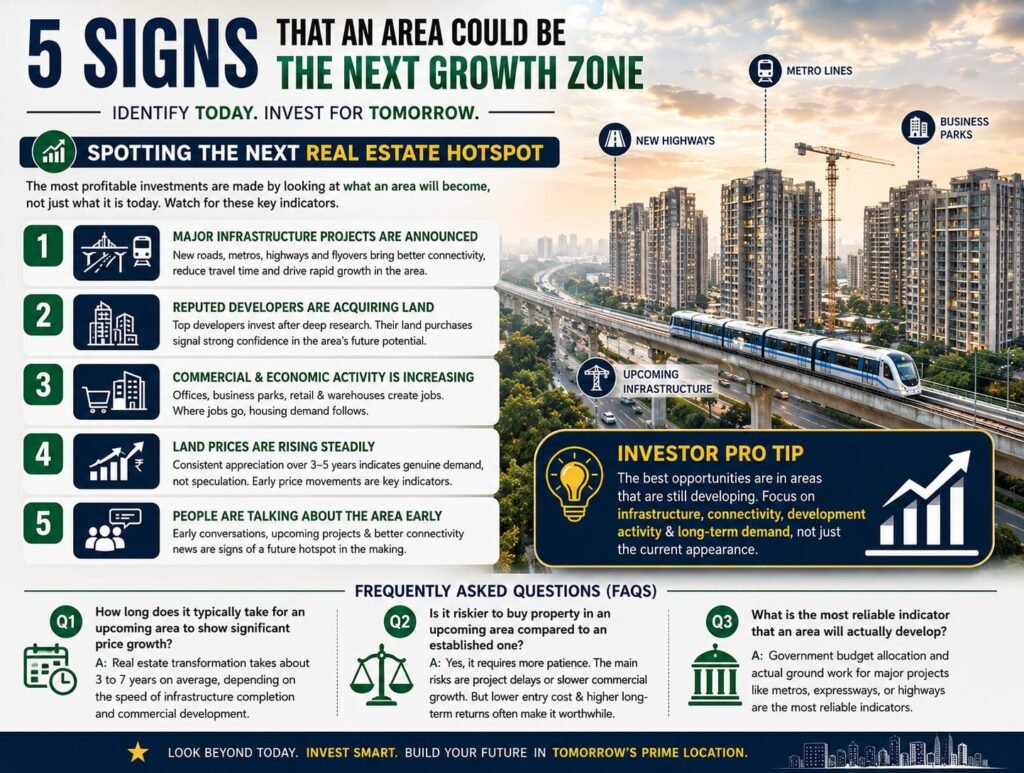
Not every location becomes a real estate hotspot. Some areas remain unchanged for years, while others suddenly attract buyers, businesses, and developers. The challenge is identifying the difference before everyone else does.
As anyone who has tracked real estate knows, the most profitable investments are made by looking at what an area will become, not just what it is today. Spotting a future real estate hub early requires looking beyond the current dust and construction to see the underlying potential.
Quick Summary: Spotting the Next Real Estate Hotspot
If you are short on time, finding the next big growth zone comes down to watching where money and infrastructure are moving. A future hotspot is hidden in plain sight, marked by massive upcoming transport projects, active land acquisition by reputed developers, and an influx of commercial spaces like offices and retail hubs. Steady, non-speculative land price growth combined with early market chatter indicates a neighborhood on the rise. Investing during this transition phase, before the area is fully developed, allows you to enter the market at a lower price point and maximize your long-term returns before the general public catches on.
1. Major Infrastructure Projects Are Announced
When the government starts investing in roads, railway stations, metro lines, highways, or flyovers, it is usually a sign that the area is expected to grow rapidly.
Better connectivity reduces travel time and immediately attracts residents, businesses, and developers. Many of today’s premium locations saw significant price appreciation only after transport infrastructure improved. If you see major transit corridors being cleared, the neighborhood is on track for a transformation.
2. Reputed Developers Are Acquiring Land
Large developers spend months researching locations, analyzing demographics, and predicting future urban sprawl before investing a single rupee. If reputed builders are launching projects or purchasing large land parcels in a particular area, it signals massive confidence in the area’s future.
They do not invest based on today’s demand alone—they invest based on where demand is guaranteed to move in the coming years. Following the footprint of established builders is one of the safest ways to spot a rising zone.
3. Commercial and Economic Activity Is Increasing
Sustainable real estate growth does not come from residential projects alone; it requires an economic engine. The arrival of new offices, warehouses, business parks, shopping centres, and retail spaces creates local employment.
Where jobs go, housing demand invariably follows. When people can work, shop, and live within a reasonable radius, a suburban area quickly matures into a self-sustaining ecosystem.
4. Land Prices Are Rising Steadily
A sudden, overnight spike in prices can be a sign of risky market speculation, but consistent growth in land values over three to five years indicates genuine, increasing demand.
When serious investors, developers, and end-users start showing quiet interest in a location, land prices are usually among the first indicators to move upward. Paying attention to these early transactional shifts can help you buy in before prices skyrocket out of reach.
5. People Are Talking About the Area Before It Is Fully Developed
Every successful growth zone goes through a phase where infrastructure is still under construction, but conversations about the area begin increasing among industry insiders and early buyers.
You start hearing about upcoming projects, new roads, better connectivity, or future business hubs long before they are visible on the ground. At this stage, the area may not look impressive to the average visitor, but that raw, transitional phase is exactly when the biggest financial opportunities exist.
Investor Pro Tip: The best investment opportunities are rarely found in locations that are already fully developed. By then, much of the growth has already been reflected in property prices. A future growth zone is usually easy to miss because it does not look like one yet. The key is to focus on infrastructure, connectivity, development activity, and long-term demand rather than judging an area only by its current appearance.
Frequently Asked Questions (FAQs)
Q1: How long does it typically take for an upcoming area to show significant price growth?
A: Real estate transformation is a long-term process. Generally, it takes about three to seven years for an area to transition from an announced growth zone to a fully functional, high-demand neighborhood, depending on the speed of infrastructure completion.
Q2: Is it riskier to buy property in an upcoming area compared to an established one?
A: Yes, there is a higher element of patience required. The main risks involve infrastructure project delays or slower-than-expected commercial development. However, the lower entry price and higher potential for long-term profit often justify the wait for smart investors.
Q3: What is the most reliable indicator that an area will actually develop?
A: Government budget allocation and the actual commencement of ground work for major connectivity projects, like metros or expressways, are the most reliable indicators. Announcements can sometimes stall, but physical construction rarely stops completely.