
Why Are Flats Near Railway Stations So Overpriced? (And Is It Worth It?)
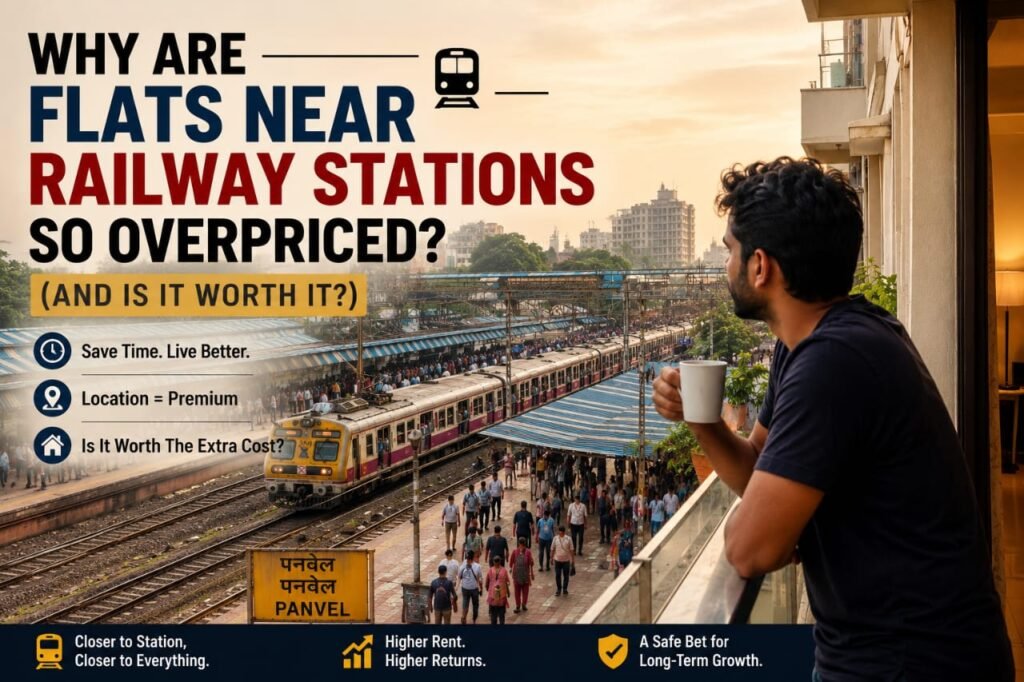
Let’s be honest. If you’ve ever gone house hunting, you’ve probably faced this annoying reality: you find a beautiful, spacious 2 BHK, but the moment the broker tells you it’s a 25-minute auto ride from the nearest station, your heart sinks. On the flip side, a smaller, average-looking flat that’s just a 5-minute walk from the platform costs almost 20% more.
Why does this happen? Why do railway stations have this weird superpower to inflate property rates?
It’s not just random luck. If you want to understand why transit properties command such a crazy premium—and whether you should actually pay it—let’s look at the raw reality.
📌 WHAT is the real reason behind this “Station Premium”?
At the end of the day, people aren’t just buying brick and mortar; they are buying saved time.
Think about it. In any busy city, daily commuting is the biggest energy drainer. If you live right next to a railway station, you are essentially buying back 1 to 2 hours of your life every single day. You don’t have to fight with auto-drivers, you don’t get stuck in traffic bottlenecks, and you reach home early to see your family. That is exactly what people are willing to pay a premium for.
But there’s a snowball effect too:
The Commercial Magnet: Businesses know that thousands of people walk out of a railway station every hour. Naturally, banks, supermarkets, top schools, clinics, and restaurants rush to open their branches right there. Within a few years, a sleepy area transforms into a fully developed hub just because of that train track.
The Tenant Obsession: If you’re renting, what’s your number one priority? Connectivity. A flat near a station almost never sits vacant. Tenants are more than happy to pay an extra ₹3,000 to ₹5,000 a month just to avoid a painful daily commute. For an investor, this means consistent rental income without any gaps.
📍 WHERE do you get the best value? (The Distance Dilemma)
You don’t want to buy a house too close to the station either. Living right on top of the tracks sounds convenient until you realize you can’t sleep because of local train announcements and constant honking.
You need to know how the pricing works based on where the property is situated:
The 0 to 1 KM Radius (The Pure Walking Zone): This is where prices are touching the sky. It’s perfect for bachelors, young professionals, or pure rental investors who only care about zero-travel time. But it can get incredibly noisy and crowded.
The 1 to 2.5 KM Radius (The Sweet Spot): In my opinion, this is where the real magic happens. You are far enough to escape the chaotic station traffic and train noise, but close enough that a 5-minute shared auto or a quick cycle ride gets you to the platform. Here, you get better building amenities and a quieter environment for a saner price.
Beyond 3 KM (The Crash Zone): The moment you cross the 3 km mark, the station effect fades away. Prices drop significantly. If you buy here, you are relying entirely on the internal development of that specific pocket, not the railway network.
🛠️ HOW do you actually play this market without getting ripped off?
If you’ve decided that you want to buy a property near a transit hub, don’t just blindly sign the check. Here is how you should evaluate the deal like a pro:
1. Spot the “Upcoming” Hubs Early
If you buy a flat near a station that has been fully operational for 15 years, you are paying the peak price. The smart money is made by tracking future infrastructure. Look for areas where new metro lines, subways, or suburban rail extensions are currently under construction. Buy there before the station opens. That’s how you get massive capital appreciation.
2. Audit the Traffic and Chaos
Go visit the property on a Tuesday evening at 7:00 PM. Don’t go on a quiet Sunday morning. See how messy the approach road gets during peak rush hours. If the road leading to your building is jammed with vegetable vendors, illegal parking, and autos, your quality of life will suffer, and it will be incredibly hard to find a buyer when you want to exit.
3. Don’t Ignore the Psychological Factor
Good transport gives people a psychological sense of security. Even during a market slowdown, properties near major stations don’t crash because the demand is fundamentally tied to survival and jobs, not just luxury. It’s a great safety net for defensive buyers.
🔑 The Bottom Line (TL;DR)
What: Station properties are expensive because they sell convenience, eliminate last-mile transport struggles, and act as commercial hubs.
Where: Skip the chaotic 0-1 km circle if you want peace of mind; lock your money in the 1-2.5 km sweet spot instead.
How: Don’t buy into existing expensive hubs—spot upcoming transit lines early, check the traffic situation at peak hours, and buy for long-term safety